
Moenieba Isaacs, Siphesihle Mbhele, Ayanda Madlala
The Ingonyama Trust Board invited the Amakhosi from all districts of KwaZulu-Natal and strategic business partners like Vodacom and Old Mutual to gather in one room. From 8-10 December, delegates took their places in the Inkosi Albert Luthuli International Convention Centre in Durban for the three-day strategic meeting to discuss the Trust and its policies and governance.
The formation of the Ingonyama Trust was the outcome of a peace deal between the National Party and the Inkatha Freedom Party, when South Africa was on the brink of a civil war before the democratic elections of 1994. King Misuzulu kaZwelithini as the sole trustee and chairperson of Ingonyama Trust that governs 2.8 million hectares of land in KwaZulu Natal. The Ingonyama Trust was established by the KwaZulu-Natal Ingonyama Trust Act, which was enacted by the KwaZulu Legislative Assembly and came into effect on 25 April 1994.
For most of the Amakhosi, the meeting was critical to work out challenges and tensions with big corporations on communal land and other management and land-use issues.
The meeting’s main objectives were to reflect on the Ingonyama Trust Act 9 of 1997, identify and address challenges in the administration and management of communal land, open to new models and approaches to improve protection and management of communal land, crafting of appropriate communal land management models, and to strengthen policy for the administration of communal land.
The week’s proceedings, however, touched on none of these topics. Instead, the platform was overtaken by politics and conversations were dominated by contests over power and authority. Where does this leave rural residents and their neighbourhoods, who depend on land and natural resources as their main and often only source of livelihood?
PLAAS was invited to attend the meeting. We conduct research under the Living Landscapes in Action project in the UNESCO World Heritage Site of iSimangaliso Wetland Park (IWP). Managed by the park’s authorities, the park boasts 280 km of coastline from Maputo to Lake St. Lucia Estuary, and is made up of around 3,280 km² of natural ecosystems. It is also home to 805 682 people. Maputo National Park this year put in a proposal to merge the two parks — a move that we are concerned about. Through our 2025 policy brief, we have demonstrated why: communities in the area face constant violence; threats to their livelihood, cultural, and spiritual practices; and some people have even been killed.
The meeting programme we received on 5 December 2025 listed Ingonyama Trust Board Chairperson King Misuzulu kaZwelithini as the opener. Other key people in the opening session were the Chairperson of the KZN Provincial House of Traditional and Khoi-San Leaders iNkosi RS Shinga; Chairperson of National House of Traditional and Khoi-San Leaders Kgosi TM Seatlholo; Chief Director at the Department of Land Reform and Rural Development, Advocate Vela Mngwengwe (also Previous Head of Trust board Secretariat); board Vice-Chaiperson Advocate Linda Zuma; and Acting Head of the board secretariat, Siyamdumisa Vilakazi.
With these high level representatives, we hoped for deeper insights into the relationship between the Ingonyama Trust and IWP’s expansion programme, expanded conservation areas on communal land, and “buffer zones” created through “other effective area-based conservation measures” on communal areas that severely impede on people’s living space.
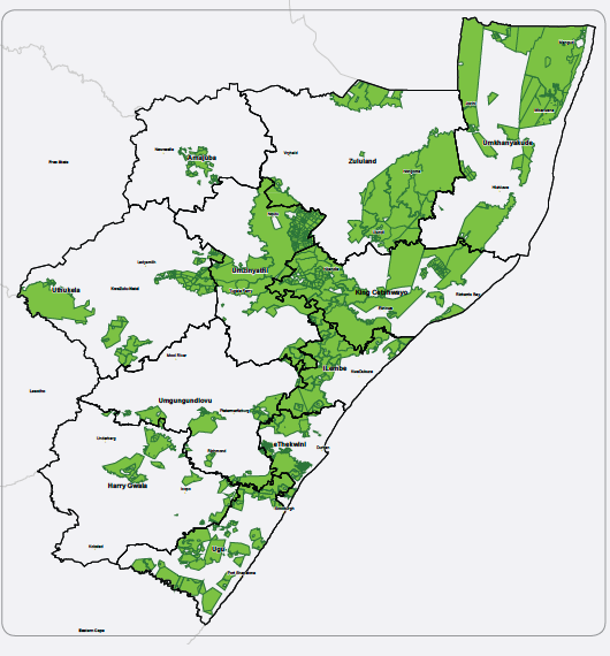
An illustration of the 2.8 million hectares of land under King Misizulu kaZwelithini’s trusteeship, sourced from the Ingonyama Trust Board’s programme and briefing document from the 8-10 December 2025 strategic meeting.
Instead, Prime Minister of the Zulu nation and MEC for Cooperative Governance and Traditional Affairs in KwaZulu-Natal TL Buthelezi said the King was not consulted or aware of the meeting and declared the R6 million event invalid. A handout dated 15 July 2025 explained the reasons why the Amakhosi of the Zulu Kingdom have no confidence in the board as it is constituted. A second handout was an email from Land Reform and Rural Development Minister Mzwanele Nyhonto, stating his intention to place the entire board on special leave. Although Advocate Zuma claimed the meeting was not political, it turned into a political circus of power and contestation, resulting in most delegates, including the Amakhosi and the government, staging a walk-out.
Some of the Amakhosi who remained posed questions on financial transparency, the board structure and functions, information on what happens to levies paid by malls on communal land, mining rights concessions, expansion of afforestation on communal land, mining rights, mission-church land still controlled by churches in Germany, and housing projects. On the second day of the meeting, we heard most Acting Head of board Secretariat Vilakazi attempting to answer all the questions posed by Amakhosi on day one. He spoke for three hours, focussing on indecipherable financial statements with no handouts, and a “death by PowerPoint” feeling in the room.
While we weren’t enlightened on the relationship between the Trust, its board, IWP and the expansion of conservation on communal land, we gained deep insights of the relationship between King Kisizulu kaZwelithini, the Ministry for Land Reform and Rural Development. The people who live and work on the land were ignored.
Rural residents in the Isimangaliso region face exclusion and criminalisation as a result of conservation. This form of conservation laid out in the proposed transfrontier merger programme for IWP and Maputo National Park, poses a great threat to communities’ livelihoods. While the Ingonyama Trust’s role in protecting the rights of these traditional communities on communal land is clear, the leaders themselves are at severe odds over their governance roles and structures.
“The Trust shall, in a manner not inconsistent with the provisions of this Act, be administered for the benefit, material welfare and social well-being of the members of the tribes and communities as contemplated in the KwaZulu Amakhosi and Iziphakanyiswa Act” — KwaZulu Ingonyama Trust Amendment Act, No. 9 of 1997.
Rather than unpacking the problems people in these communal settings face, most of the conversations at the meeting surfaced on the organised commissions on land administration, land-use management, finance, and sustainability — to underscore the power and authority of Amakhosi and investigating how traditional authorities can strengthen their influence through the Ingonyama Trust.
Vital conversations about the Trust and the King’s responsibility to ensure access to natural resources on an equitable basis for communities living next to protected areas in the province, the Trust board’s role to ensure community livelihoods are protected from violent mechanisms of fortress conservation practises, and advocacy to include communities in decision-making processes in conservation areas based in communal land (whether claimed or not), were impossible to be held. When the elephants fight, it is the grass that suffers.
