
By Boaventura Monjane
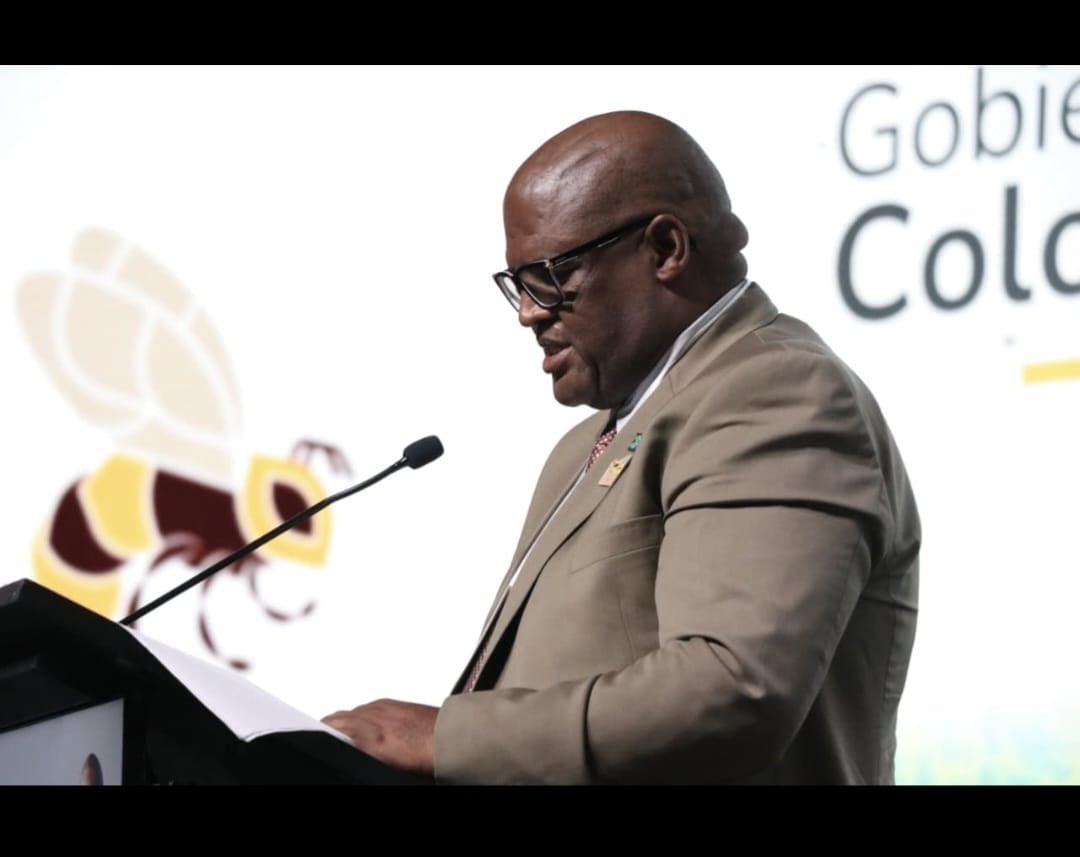
In the walled city of Cartagena, Colombia – where layered histories of conquest and resistance coexist in uneasy tension – South Africa’s Minister of Land Reform and Rural Development, Mzwanele Nyhontso, delivered a speech of striking moral force and political clarity at the Second International Conference on Agrarian Reform and Rural Development (ICARRD+20), held from 24 to 28 February.
The applause that followed was not merely diplomatic courtesy. It was recognition.
Addressing delegates under the banner “Land: Past, Present, and Future: The Struggle of Peoples for Agrarian Reform,” Nyhontso placed South Africa’s land question squarely within a broader global reckoning. Convened by the Colombian government and driven politically by Martha Viviana Carvajalino Villegas, Minister of Agriculture and Rural Development – with the backing of President Gustavo Petro, who has consistently foregrounded agrarian reform as central to Colombia’s fragile peace – ICARRD+20 was always destined to be a politically charged gathering. Yet the South African intervention distinguished itself through its candour, its firm historical grounding, and its refusal to retreat from uncomfortable truths.
Minister of Land Reform and Rural Development Mzwanele Nyhontso addressing the opening session of the 2nd International Conference on Agrarian Reform and Rural Development (ICARRD +20) in Cartagena, Colombia currently underway. The minister outlined South Africa's position… pic.twitter.com/83iCPeW5ui
— National Dept. of Land Reform & Rural Development (@DLRRD_za) February 24, 2026
From Porto Alegre to Cartagena: a broken promise
Twenty years after the first ICARRD in Porto Alegre, Brazil – which marked a significant turning point and helped catalyse important advances, including the Voluntary Guidelines on the Responsible Governance of Tenure (VGGT) and several key UN declarations – the promise that equitable access to land is foundational to peace and food security remains largely unfulfilled. Nyhontso did not sugar-coat this reality. He spoke plainly about intensifying land concentration, the marginalisation of small-scale producers and the persistence of hunger amid plenty.
His framing echoed – and implicitly aligned with – the Cartagena Declaration adopted days earlier by hundreds of academics and researchers. That declaration insists that land is not a commodity or “a financial asset,” but life itself. It calls for transformative agrarian reform built around the inseparable “4 Rs”: Recognition, Redistribution, Restitution and Regulation.
Nyhontso’s speech mapped almost seamlessly onto that framework.
He reaffirmed restitution as a non-negotiable response to “atrocious legacies of colonial and past regimes.” He underscored redistribution as pro-poor and state-led, with explicit commitments to women and youth. He emphasised recognition of communal areas and customary tenure. And he defended regulation – through expropriation and legislative reform – as a legitimate tool of democratic states.
In doing so, he signalled that South Africa is not merely participating in global debates; it is helping to shape them.
Naming the wound
The speech was powerful because it refused abstraction. Nyhontso grounded his argument in South Africa’s lived history: the 1913 Natives Land Act, apartheid’s consolidation of dispossession, and the confinement of the African majority to 13% of the land.
Invoking Robert Mangaliso Sobukwe on the eve of the 49th anniversary of his death, the minister connected contemporary policy to a longer liberation tradition. Land, he reminded delegates, was always at the heart of the struggle for national self-determination.
For South African delegates – government officials, civil society actors and academics – this was more than rhetorical flourish. It was affirmation. Thirty-two years into democracy, frustration over the slow pace of land reform runs deep. By acknowledging that progress has been uneven and that the “willing-buyer, willing-seller” model did not deliver transformation at the required scale, Nyhontso demonstrated a rare willingness to admit policy shortcomings on an international stage.
That honesty generated trust – and applause.
No compromise, no apology
Equally significant was the minister’s refusal to be defensive about expropriation and state-led reform. In a global climate where South Africa’s land debate is often distorted – including through inflammatory narratives about “white genocide” – Nyhontso rejected what he called “bullying tactics” and slanted representations.
Instead, he calmly restated constitutional principles: expropriation in the public interest, equitable access, and non-discriminatory redistribution. The Expropriation Act, the forthcoming Equitable Access to Land Bill and the Communal Land Tenure and Administration Bill were framed not as radical departures, but as instruments of decolonisation and democratic correction.
For many in Cartagena – especially delegates from Latin America, Asia and other parts of Africa – this stance resonated. Across the Global South, governments are grappling with similar tensions: how to address historical injustice while navigating volatile global markets and geopolitical pressure.
South Africa’s message was clear: the market cannot be the sole arbiter of justice.
Linking land, climate, and hunger
Another reason the speech drew strong applause was its insistence on connecting land reform to the climate and food crises. Nyhontso warned against “green-grabbing” – the displacement of communities in the name of conservation, carbon offsets or eco-tourism. He argued that there can be no just transition if it displaces small-scale producers.
This intervention cut to the heart of a growing contradiction. As governments and corporations race to meet climate targets, vast tracts of land are being enclosed for renewable energy projects, mining for “critical minerals,” or speculative carbon schemes. The minister’s insistence that agroecology, food sovereignty and secure tenure must anchor any transition placed South Africa squarely within a progressive bloc advocating systemic change rather than technocratic fixes.
It also aligned with calls for stronger implementation of the Voluntary Guidelines on the Responsible Governance of Tenure (VGGT) and for monitoring through the FAO’s Global Land Observatory – proposals that seek to move beyond declarations toward accountability.
Why a renewed sense of hope
Perhaps the most striking aspect of the South African delegation’s response was not simply pride, but relief.
Relief that their government spoke unapologetically about redress.
Relief that women and youth were foregrounded – with explicit targets of 50% and 40% respectively in redistribution.
Relief that communal areas and farmworkers were not invisible.
Relief that land reform was framed not as charity or “poverty alleviation,” but as structural emancipation.
In a domestic context where land debates often polarise and where implementation challenges fuel cynicism, the Cartagena moment offered a sense of renewed direction. By aligning South Africa with a broader international movement for transformative agrarian reform, Nyhontso’s speech suggested that the country is not isolated or reckless, but part of a global pushback against commodification and concentration.
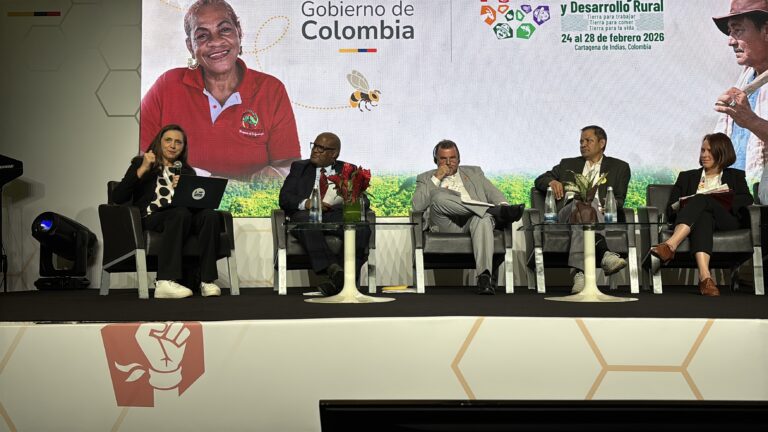
“Another challenge that emerged within the restitution programme is that in a significant number of cases, claimants opted for financial compensation instead of land,” - Mzwanele Nyhontso. The minister was making South Africa’s contributions to a panel of discussion during the… pic.twitter.com/6RLdNxkkC2
— National Dept. of Land Reform & Rural Development (@DLRRD_za) February 27, 2026
From applause to action
Of course, applause in Cartagena will mean little without measurable change at home. The true test lies in whether legislation is passed, budgets are allocated, bureaucratic bottlenecks are dismantled and post-settlement support is strengthened.
But moments matter.
ICARRD+20 may yet be remembered as a turning point – not because it produced another declaration, but because governments like South Africa’s signalled a willingness to match rhetoric with resolve.
In Cartagena, the cry of the soil was heard again. And for once, it sounded like more than lament. It sounded like commitment.
Boaventura Monjane holds a PhD in Sociology from the Faculty of Economics, University of Coimbra, Portugal. He is a research fellow at the Institute for Poverty, Land and Agrarian Studies (PLAAS, UWC).
