
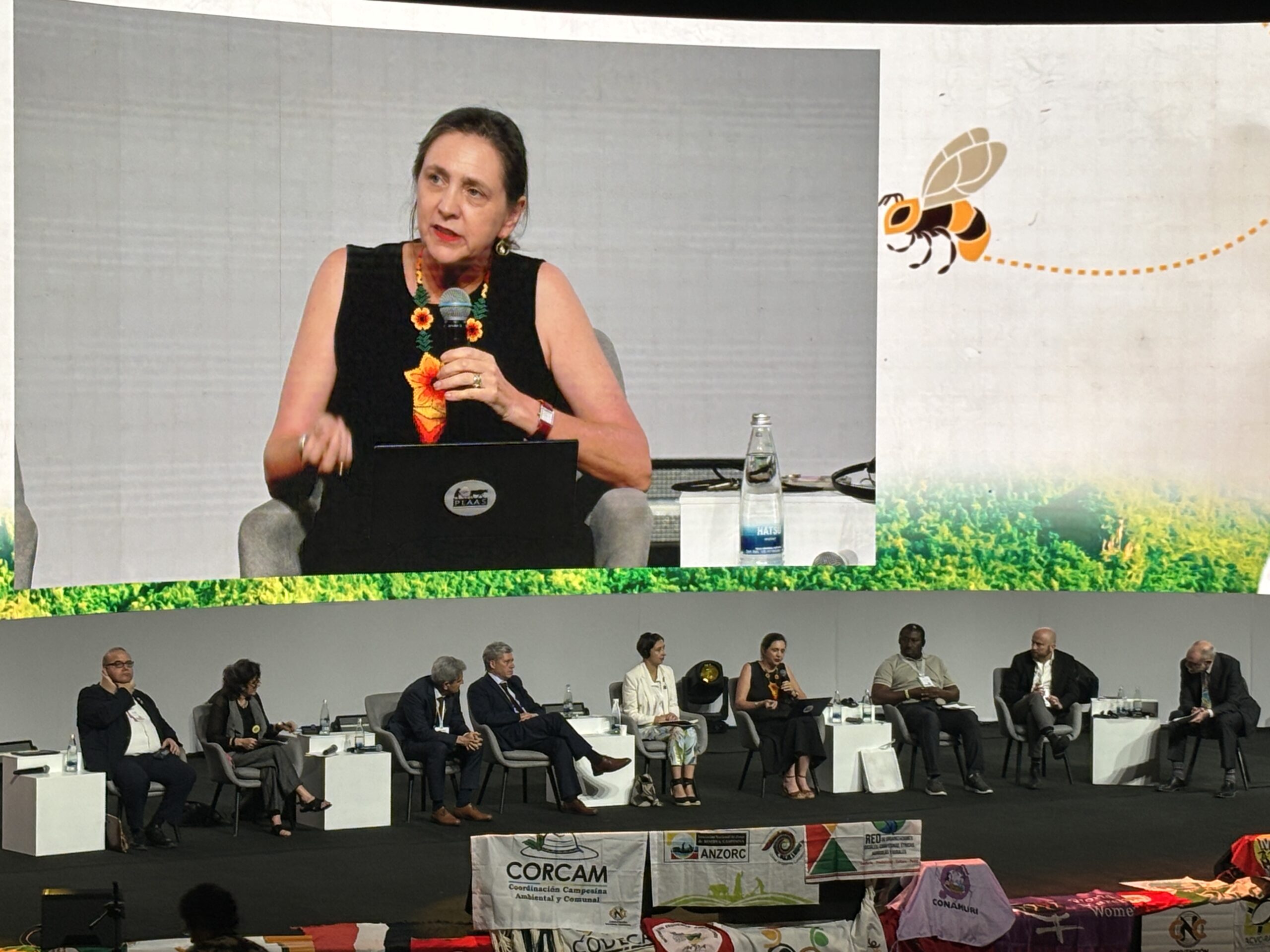
This opinion blog is based on input by Professor Ruth Hall at the second International Conference on Agricultural Reform and Rural Development (ICARRD+20). During this session, the UN’s Food and Agriculture Organization launched their global Status of Land Tenure and Governance report. Download the report here.
The Status of Land Tenure and Governance report confirms that the world has a land inequality problem. It provides an overwhelming basis for the call from this ICARRD, that land redistribution must be placed at the centre of efforts to address the interlocking crises of poverty, hunger and ecological crisis.
At the second International Academic Conference Land, Life and Society last week, the Cartagena Declaration called for redistribution, alongside recognition, restitution and regulation of land. It provided evidence of the drivers of concentration, and showed scientific evidence concerning the outcomes of land inequality
What all this points to is that inequality is not good for society or the planet. Inputs and interventions at the academic conference, and testimonies from the social summit that followed afterwards show that inequality is:
- bad for us as people;
- bad for poverty;
- bad for food security and nutrition;
- bad for society and the social fabric;
- bad for the economy, because stunted domestic demand constrains all sectors;
- bad for security because of conflict it creates;
- bad for democracy as instability, political polarisation, right-wing politics, and authoritarian power rises; and
- bad for the environment as invariably large-scale mega-farms deplete biodiversity, and monocultures strip soils and drive emissions.
My specific observations are:
1. Inequality is shocking, at a global level and across continents. But it is also not surprising.
This needs to form a baseline for regular reporting so that the direction of change can be determined at country level. We know from research that this is both due to concentration of existing landholdings, and also privatisation of the commons – the spaces where nature is best preserved.
So there is a tragedy of the commons, which is that the commons are shrinking and under threat from processing of privatisation and ecological degradation.
Sub-Saharan Africa and South Asia have the lowest levels of land inequality. These are crucial areas where large and rapidly growing populations are fending off pressures on land. This is where defence against concentration and redistribution are urgently needed. There is a lot of activity on land law and policy, especially in Africa, but it is not particularly strong. Many are still a far cry from adhering to the Tenure Guidelines
In Africa, the settler-colonies of Kenya, Zimbabwe, Namibia, SA have struggled and mostly, with the exception of Zimbabwe, have failed to overcome the racial inequality of colonialism and apartheid. But other countries are now seeing not only corporate land grabbing and replacement of smallholder communities with large-scale plantations and estates, but also the rise of medium-scale farmers who cumulatively are driving new patterns of landlessness.
The difference between the settler-colonies and other post-colonial states is shrinking as land inequality rises in those countries that did not have massive dispossession in the colonial era. Unless confronted and reversed, this dangerous concentration threatens to produce the kind of surplus populations of people without a home, land, and livelihoods.
Compounded with urbanisation, industrial agriculture, climate projects, mining and extractive industries combine in what IPES-Food calls the Land Squeeze.
2. Law and policy reform is needed on women’s land rights.
The gender gap is worrying in itself, but it is likely worse if you consider that the gap between policy and practice is even more severe when it comes to women’s rights.
3. Those that adopted new land reforms don’t score better when it comes to practice. There’s an implementation gap.
4. It is unfortunately not a surprise that – despite important advances in law and policy in some countries after VGGT – the percentage of people who feel their tenure is insecure is actually rising.
You may not have noticed, but that increase of people who feel their rights to land are insecure has risen 4%, from 19% to 23%. In fact, this is a 21% increase in four years. This is alarming; it suggests that while our international norms have been strengthened, access to land is becoming more precarious. Clearly, the commitment here must be to reduce people’s perception of insecurity.
5. Focusing on financial institutions is valuable and more detail is needed.
6. The report shows that the world has a data problem. Political commitments are made, SDG targets are set – but we do not have the mechanisms at country level to collect and publish data accurately. This is a challenge for us as academics, and a challenge for GLO. We should all be working together to plug this gap.
7. This report comes amid profound uncertainty about our global order – attacks on our multilateral institutions. It provides an important reminder of the power and value of the FAO as a UN body to inform and guide global development.
I have an observation about how we think about the concepts in this report
Caveat 1:
How much land is documented does not in fact tell us anything about security. Lawry et al’s systematic review in Africa shows that formalisation does not correlate with tenure security because many customary systems that are informal are in fact very robust. We know from numerous studies that formalisation can produce the opposite effect, especially if it takes the form of individual titling. When some are titled, others in customary systems are rendered less secure. In the next report, it would be great to see each country mapped according to both inequality and insecurity – let’s not infer that documentation correlates with security.
Caveat 2:
This report focuses on land but the Tenure Guidelines focus more holistically on land, fisheries and forests. I propose that to become the authoritative report that allows a global stocktaking of the status of tenure governance, its scope should align with the Tenure Guidelines, and include fisheries and forests – so that it addresses the natural resources that underpin food security, as intended by the CFS. Is this in fact the plan?
Across different contexts, rising land inequality poses problems. Are we to be depressed? No. What we need to do is very clear and we are here to affirm a commitment and a plan to turn the tide on the insecurity and inequality this report shows. ICARRD in 2006 led to profoundly significant victories: Tenure Guidelines, also African Union’s Guidelines, UNDRIP and UNDROP. These are all crucial. But they are no longer enough.
What’s needed is not more guidelines. What we need to do is:
- advance the Tenure Guidelines and strengthening redistribution, restitution, recognition and regulation;
- call on states to strengthen law, policy and implementation, and to promote the Tenure Guidelines;
- strengthen reporting and accountability mechanisms; and
- invite research institutions and civil society structures and social movements to collaborate to track progress.
This ICARRD then needs to do at minimum three things:
- Declare that land inequality is bad for human rights, development, democracy and the environment.
- Put land redistribution back on the agenda, and at the centre of land governance and rural transformation initiatives.
- Set out a path for all member states of the United Nations to commit to tackling inequality through redistribution of land anchored in associated agrarian reforms of rural infrastructure for small-scale and family farmers and restructuring water rights and markets.
Land Gini coefficients should be widely known and tracked, as a measure of economic exclusion and inclusion. Benchmark every country in the world – not whether they have passed a law or policy, but track progress in outcomes for reduced inequality and greater security.
We should collectively thank the FAO for delivering this report. This is precisely what the FAO is for, to provide this mirror to the world, and to use this to inform action.
