By Moenieba Isaacs and Siphesihle Mbhele
Pictures by Tracey Lee Dennis
Editing: Deshnee Subramany
Main image by Ashraf Hendricks, courtesy of GroundUp.
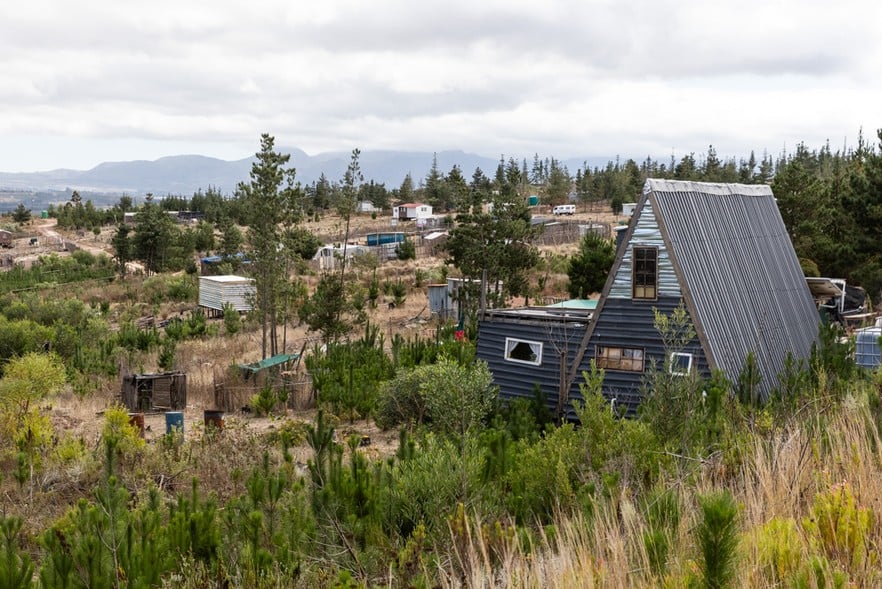
In 2020, Knoflokskraal was established as a Khoisan land occupation site near Grabouw in the Theewaterskloof Municipality, Western Cape. The occupied land spans about 1,800 hectares of former forestry land, which is vested with the Department of Public Works and Infrastructure. On 5 November 2020, at the height of the COVID-19 pandemic, a group of people occupied the space supported by members of the Knoflokskraal Royal House, Queen Eloise and the Grabouw Khoisan Council. By the time Senior Chief Wilhelm Absalon of the House of Cochuqua and his father joined the first collective two weeks later, there were about 100 people in the space made up of bush and without running water. There are now about 4,000 houses in the area, which the department estimates housing at least 15,000 people, and the area now has its own restaurant, farms, and livestock.
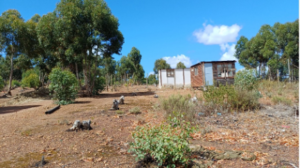
The land occupation was part of a movement of indigenous families reclaiming the land, creating a self-sustaining settlement as part of their broader struggles for recognition and restitution. The settlement now hosts indigenous Khoisan communities who view Knoflokskraal as a cultural homeland where their languages, traditions, and governance systems can be revived. The community’s aspirations include establishing self-sufficient livelihoods through farming, conservation, and cooperative structures. They want to create language and cultural centres to preserve and teach indigenous knowledge; and to integrate Khoisan heritage and languages into education systems.
On 29 October 2025, PLAAS’s Living Landscapes in Action short course included a field trip with members of Knoflokskraal’s indigenous groups. Our 2025 New Thinking on Integrating Biodiversity and Social Justice short course alumnus Kamogelo Pshatlele, a field ranger from Mapungubwe National Park, asked about the news headlines on Knoflokskraal and Minister of Public Works Dean McPherson’s decision to go back to court to evict the groups. Last year, the Department said “the rule of law must be respected“, referring to the occupation as an “invasion“. In May 2026, the Department said it spent over R41-million on the settlement and private security to contain the area from further occupations, and the Minister said said that “the rule of law does not exist” in the area.
As it stands, the Department of Public Works and Infrastructure is headed back to court to apply for a new containment order. Job Morris from Botswana told PLAAS that African Community Resource Rights Alliance (ACRRA) tried to assist indigenous groups with legal support and is still willing to do so. However, more research is needed to fully understand the complexities of this and the current standoff between those on the land and the government. PLAAS will return to Knofloksraal next month, and a visit to the area will be included in the field trip for our 2026 short course later in the year.
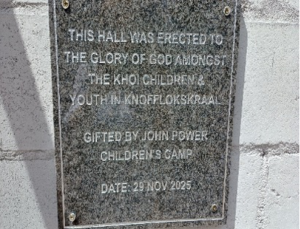
Knoflokskraal is but one example of numerous societal struggles for land, livelihood, culture, heritage, and resources. Rather than criminalising vulnerable communities and their visible resistance to social pressures, we should understand it within a historical and economic context. It is a testament of what happens when people feel that they have been failed. Continuous and persistent activism on spatial and social justice is necessary, where advocacy for social housing and access to land and nature is prioritised, as per the South African Constitution.
The question of land is a question of life, dignity, culture, and belonging. Now, land occupation movements are under threat in South Africa with the proposed amendments of the Prevention of Illegal Eviction Act. With a particular provision proposing to criminalise incitement of occupation through fines or imprisonment, individuals and families who need land and homes are at further risk of homelessness.
We need to think about land justice and land reform in the context of conservation as advocacy not only for the access to land, but to resources and the control of natural resources by indigenous people. Land reform should interrogate debates that focus on agriculture and farming alone, and push for a holistic understanding that is cognisant of diverse meanings and uses of land connected to livelihood, spirituality, and belonging. This will prevent the perpetual reproduction of processes of dispossession, and exclusion of indigenous people residing next to protected areas from their natural resources.