
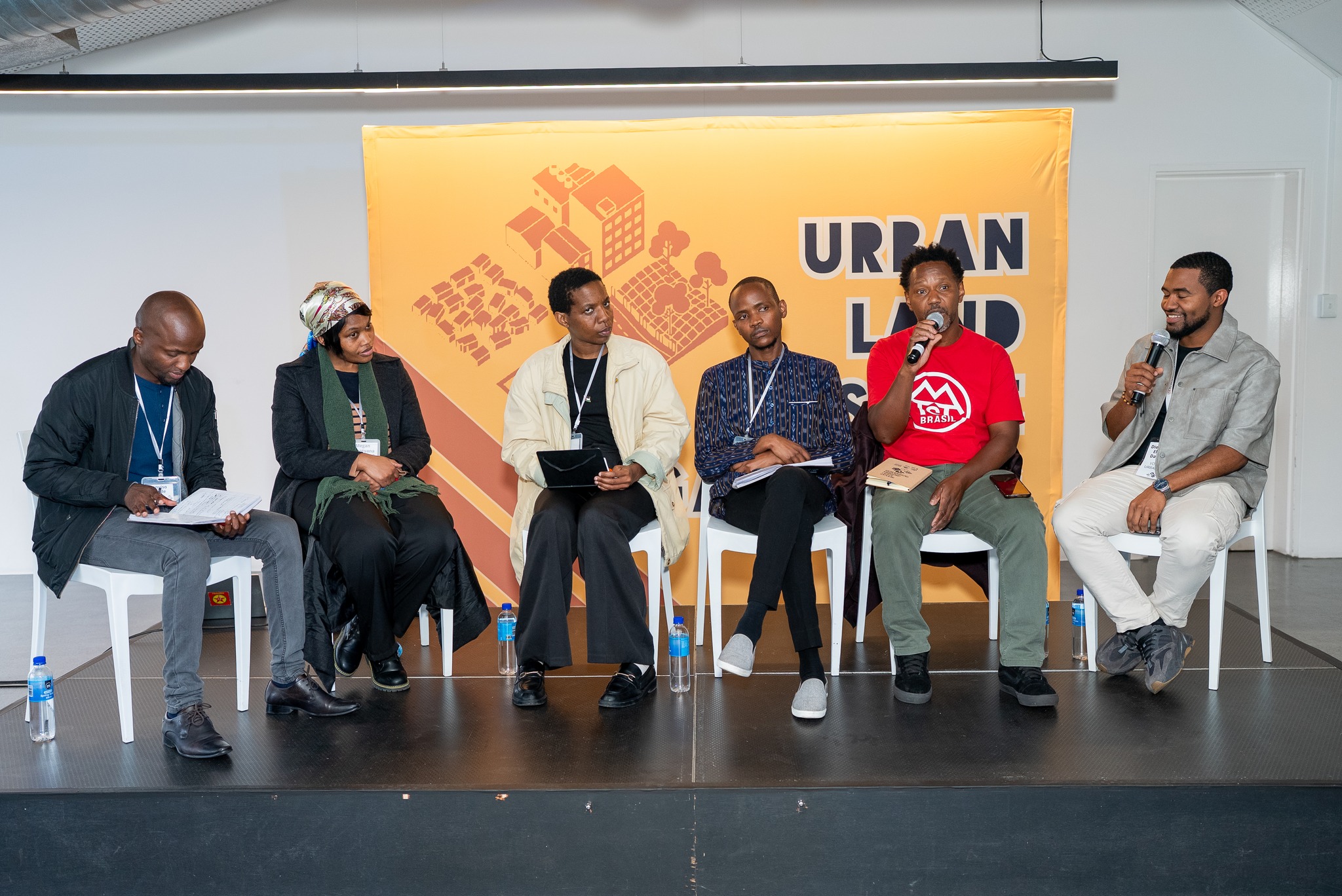
The Urban Land Justice Gathering brought together activists, community leaders, academics, residents, and political parties to address the deep-rooted crisis of land dispossession, spatial injustice, and housing inequality in South Africa, with a specific focus on Cape Town.
The discussions traced the historical roots of dispossession from colonialism and apartheid to its contemporary manifestations through gentrification, market-led policies, and state inaction. A strong emphasis was placed on the need for healing, reparations, community-led solutions, and holding the state and political parties accountable.
- See pictures from the event here.
DAY 1
Panel 1: Historical and contemporary context of land dispossession
Theme: Understanding the deep historical roots of land theft and how they inform present-day spatial injustice and gentrification.
Gordon Metz (Ratepayers Association): Used the history of the V&A Waterfront and Sea Point, built by prisoners and on the legacy of slavery, to argue that custodians of valuable land have a responsibility to make this painful history accessible as a first step toward healing and justice.
Ebrahim Christian (Bo-Kaap Civic): Described the ongoing fight in Bo-Kaap against economic dispossession through skyrocketing rates and gentrification, forcing out long-standing communities. He highlighted the irony of an area once declared a “slum” now being coveted by developers.
Kenneth Matlawe (Housing Assembly): Argued that land dispossession is not just about physical land but also the loss of language, culture, and custom. He connected the housing struggle to all other working-class struggles (water, electricity) and emphasized that economic exclusion from areas like the Waterfront is a continued form of dispossession.
Tauriq Jenkins (Save our Sacred Lands): Framed dispossession as a “de-Africanisation” project, commodifying African pain (e.g., the Waterfront). He powerfully stated there is “no such thing as an illegal occupation,” only a right to return, and criticized the Constitution for failing to reverse historic land theft.
Panel 2: Urban injustice: challenging exclusion
Theme: The specific mechanisms of exclusion in urban centers, focusing on gender-based violence, policy failures, and the role of the state and law.
Lungelo Mnowabane (SERI): Presented findings on the gendered violence women face in informal settlements, including limited access to basic services and barriers to leadership. Recommended gender-responsive infrastructure and policies.
Jacqui Cuyler (1 to 1 – Agency of Engagement): highlighted the stark realities of inner-city life, where access to basic water and sanitation is a critical issue. She questioned the definitions of “adequate housing” and criticized the dangerous conditions of shared toilets.
Frieda Motshwane (Inner City Federation): Shared lived experience of organizing against evictions and addressing GBV in occupied buildings in Johannesburg, emphasizing community-led governance and education.
Ruth Hall (PLAAS): argued that property is a social relationship, not just a thing. She critiqued the state’s risk-averse, market-based approach to redistribution and called for using existing constitutional tools (Section 25(5)) to prioritize land for those in greatest need through transparent processes.
Panel 3: Tenure security and its role in sustainable land access
Theme: Moving beyond narrow legal definitions of ownership to understand tenure security as fundamental to dignity, citizenship, and life.
Community Perspectives (Karen Hendricks of Reclaim the City, Kashiefa, Achmat of Housing Assembly, Wiseman Mpepo of Intlungu yaseMtyotyombeni, Brian Adams of Surplus Peoples Project): Panelists from various movements detailed the pervasive precarity of life without tenure security. This includes being labeled “hijackers,” facing eviction even with title deeds (due to debt or the inability to pay), women’s vulnerability after divorce, and the trauma of constant police brutality (“post-traumatic occupation disorder”)
Limitations of Current Policy: The discussion highlighted that government responses often amount to “charity work” that doesn’t address systemic issues. The real “villain” was identified as business interests that the state consistently prioritizes over people.
The Solution is People Power: The resounding conclusion was that communities are not the problem but the solution. There is a need to re-imagine alternatives, center
community power, and force the state to collaborate through organized collective action.
DAY 2
Panel 1: Financing land reparation, property tax, expropriation and redistribution
Theme: Exploring practical financial mechanisms and policy tools for achieving land justice and reparations.
Justice Naledzani of the HDA: Explained the government’s role in facilitating land release from state departments, citing challenges with high urban land prices and bureaucratic delays within departments like Public Works.
Academics & Planners (Alison Tshangana, Astrid Rosemary Ndagano Haas , Helen Rourke of DAG, Dr Cecil Madell of UCT Department of Planning):
Reparation must include location, tenure security, and support for entering the market.
Must critically examine the property market and find ways for the state to capture value created by public investment (e.g., rezoning, MyCiti bus routes) for public good.
Urban planning tools (zoning, spatial frameworks) are currently used to exclude and need to be radically repurposed for inclusion, e.g., by flooding well-located corridors with development rights to lower prices.
Challenges Identified: Lack of state capacity, no political appetite for rent control, and the failure of social housing models to remain affordable long-term.
Panel 2: Overcoming political and social barriers to land redistribution
Theme: Holding political parties accountable for their policies and actions (or inaction) on urban land justice.
- Watch the political debate here
Facilitator: Mazibuko Jara – Zabalaza Pathways Institute
Panel: MP Cameron Dugmore – African National Congress COCT MMC Carl Pophaim – Democratic Alliance MPP Brett Herron – GOOD Party MP Virgill Gericke – Economic Freedom Fighters COCT Cllr Cheslyn Steenberg – Patriotic Alliance Parliamentary Researcher Francesca Visagé – Rise Mzansi Buhle Booi – Ndifuna Ukwazi Head of Political Organising & Campaigns
Different Kinds of Solutions
ANC, EFF, GOOD: Supported expropriation (with or without compensation) and a more active state role in redistributing well-located land. GOOD and ANC specifically criticized the DA for blocking projects like Tafelberg.
DA: Emphasized using state land first, exploring innovative technologies, and engaging on specific cases, but remained opposed to expropriation without compensation.
Rise Mzansi, Patriotic Alliance: Focused on practical policies: regulating Airbnb, ensuring dignified housing conditions, providing services on all occupied land, and introducing a land value tax.
EFF and Patriotic Alliance: Focused on restricting foreign ownership and fast-tracking redistribution.
Comments and Questions from the floor: People overwhelmingly expressed frustration with performative actions, “tick-box” participation, being relocated to peripheral areas, and being criminalized for reclaiming land.
Key Outcome: All parties committed to attending a Community Assembly in Khayelitsha on September 11th to continue the dialogue and be held to concrete commitments, representing a significant step toward sustained accountability.
Panel 3: Land redistribution strategies
Themes: Centering the voices of occupiers and redefining principles for redistribution based on community needs and holistic well-being.
Megan Bobotyane and Nikelwa Maqula Spoke from direct experience, arguing that occupations are a solution to state failure and a form of land reform. They highlighted the state’s violent response (evictions, arson) and the need for healing, safety, and infrastructure. Their core principle: “Nothing About Us Without Us.”
Siphesihle Mbhele: Introduced the critical issue of conservation vs. community, where protected areas dispossess people of their right to use land for grazing, foraging, and cultural practices.
Edson Luiz Basilio dos Santos – Movimento dos Trabalhadores Sem-Teto (MTST): Showcased a model where occupations are not just about housing but building solidarity and political power through collective education, communal kitchens, and upskilling, creating a counter-culture to individualistic mindsets.
Collaborative action plan
Problem 1: Broken fiscal accountability
Problem: Municipal, provincial, and national authorities avoid intervening in property markets to ensure redress and prevent inequality. This is exacerbated by a lack of transparency in budgeting, where the public cannot see how funds are used or reclaimed, leading to unaccountable fiscal governance.
Proposal: To establish a robust system of fiscal transparency and participatory budgeting that places people at the centre of financial decision-making, ensuring public funds are used to change lives and are accounted for.
Action: Develop Public Participation Policy; legislate accountability mechanisms for budgets; implement Brazilian-style participatory budgeting; mandate capacity building for residents on municipal functions and for councillors on fiscal language; ensure community influence on the IDP and Budget Implementation Plan (BIP) before council approval.
Outcome Intended: Residents understand and directly influence municipal budgets; council choices are publicly justified; communities can hold authorities accountable for spending; resources are redirected to meet public priorities.
Problem 2: Inadequate responses to unlawful occupation
Problem: The state’s approach to securing tenure following unlawful occupation is limited and often punitive, focusing on eviction or standard solutions like “site and service” rather than recognising existing occupations as communities in need of security and services.
Proposal: To shift the state’s response from criminalisation to regularisation by recognising occupations as alternative housing and providing secure tenure, basic services, and integration into city planning.
Action: Recognise possessory rights to protect against eviction; issue forms of legal recognition (e.g., Permission to Occupy); refurbish buildings; provide basic services on a needs basis; de-weaponise service provision; integrate occupations into IDPs, ward plans, and community forums; develop Site and Service schemes.
Outcome Intended: Residents of occupations gain secure tenure and access to basic services; occupations are budgeted for and planned into the city’s future; evictions are prevented through legal recognition; communities engage meaningfully on their future.
Problem 3: Broken planning and regulatory framework
Problem: The fiscal and regulatory frameworks for local government, human settlements, and planning are ineffective and disconnected from local realities. Planning education often focuses on Western problems, and communities lack understanding of how to influence policy.
Proposal: To reform planning processes to be more agile and community-centred, creating mechanisms for communities to effectively influence policies that affect their lived realities.
Action: Create a priority by-pass mechanism in planning regulations (similar to emergency procurement); educate communities on policy adoption processes; assess and utilise existing community spaces for policy influence.
Outcome Intended: Planning regulations are responsive to community emergencies; communities are empowered to effectively participate in and shape policies; state priorities align with the lived realities of residents.
Problem 4: Malicious public consultation processes
Problem: Public engagement is often a tick-box exercise where pre-determined solutions are imposed rather than co-created. There is a significant chasm between policy mandates and the instruments for public participation, leading to a lack of transparency and tangible outcomes.
Proposal: To institutionalise genuine, co-creative public participation through a legally binding by-law that ensures transparency, accessibility, and tangible results from consultation processes.
Action: Develop a Public Participation By-law and policy; challenge regulations around electing ward committees; create easier complaint and feedback mechanisms; form a cross-departmental committee to ensure community priorities are met; become literate on national policy frameworks to empower communities.
Outcome Intended: Participation processes result in tangible outcomes; the public has sufficient information and accessible channels to engage; community priorities are directly reflected in government actions; the chasm between policy and implementation is bridged.
Problem 5: Dehumanised emergency housing response
Problem: Emergency and transitional housing is treated as a technical, infrastructural problem rather than a humane response to a housing crisis. This results in inadequate grants, poorly located housing, and evictions without adequate alternatives.
Proposal: To reframe public housing as a dignified response to a social crisis by increasing funding, prohibiting evictions without alternatives, and building well-located transitional housing.
Action: Amend the Emergency Housing Policy; increase the Social Housing Grant from 3% to 30% of the human settlements budget; explore different building materials; mandate that evictions cannot be granted without adequate alternative housing.
Outcome Intended: A significant increase in funding for social housing; well-located, dignified transitional housing; an end to evictions into homelessness; a housing system that treats people with dignity.
Problem 6: Exclusionary land-use choices
Problem: Choices around land-use and land release disproportionately benefit property developers and the wealthy (e.g., malls over housing), and the process is complex and uncoordinated, locking out community-beneficial uses like urban agriculture.
Proposal: To prioritise social and housing needs in land-use decisions by simplifying processes, improving inter-departmental coordination, and identifying well-located land for community benefit.
Action: Relook processes for land identification and release; create SOPs for inter-departmental coordination; zone for urban agriculture; identify land parcels for housing and social uses; conduct community skills audits; place land in a Community Land Trust.
Outcome Intended: Well-located land is released for affordable housing and social uses; cities achieve greater food sovereignty; land-use processes are efficient and coordinated for the public good.
Problem 7: Land speculation and banking
Problem: Speculative land holding and “land banking” artificially raise property values and leave buildings to deliberately deteriorate, while the proliferation of uses like churches on open space highlights a conflict over the social value of land.
Proposal: To reclaim the value of land for socially productive reasons by challenging speculative practices, introducing taxes, and using well-located land for affordable housing.
Action: Launch public campaigns to redefine “value”; introduce a property tax on vacant land; use expropriation regulations for public benefit; prioritise well-located land for affordable housing; formalise occupations.
Outcome Intended: Speculative land holding is disincentivised; well-located land is used for affordable housing; the public understands land as a social good rather than a purely financial asset.a
