
On 20 May 2026, the Minister of Land Reform and Rural Development, Honourable Mzwanele Nyhontso, in his budget vote speech indicated that his department was working on an Equitable Access to Land Bill. The Bill was due to be presented in Cabinet and then released for public comment in June 2026 and has not yet been published. It is now anticipated that the Bill will be issued for comment next year.
We welcome this move as organisations working towards land justice. We have long called for such a law, which will entitle people to claim their right to equitable access to land. The Bill of Rights states that ‘The state must take reasonable legislative and other measures, within its available resources, to foster conditions which enable citizens to gain access to land on an equitable basis.’ [Section 25(5) of the Constitution]. For 30 years there has been no national law to give effect to this right to land.
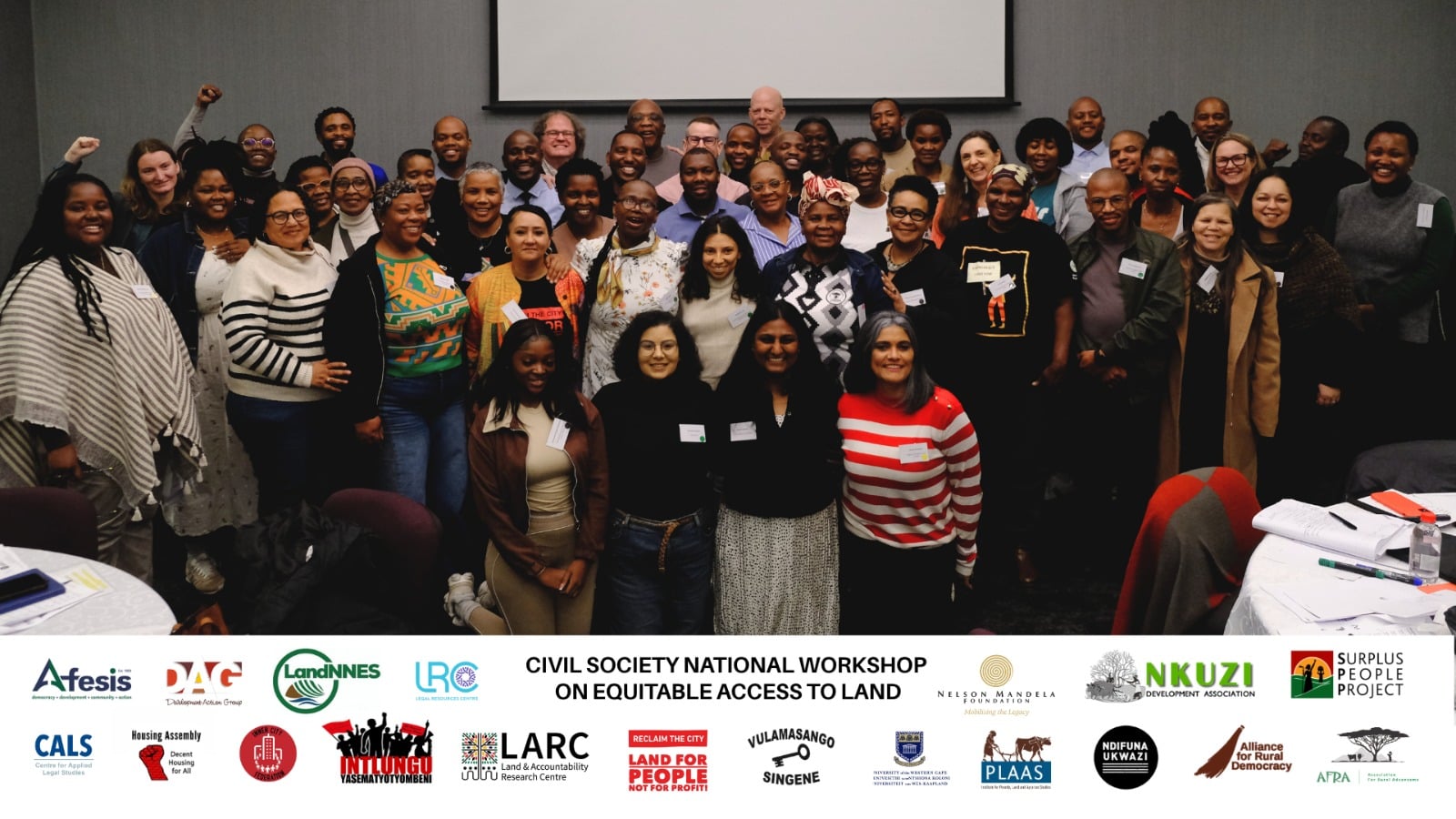
As a group of over 50 people from 40 different social movements, communities, civic, education, legal, and research organisations leading land justice work, we gathered recently in Cape Town for a two-day Civil Society National Workshop on Equitable Access to Land. We strategised what would make the new Bill just for the majority of South Africans who remain landless and poor. With participants working in rural and urban land struggles from all nine provinces, we co-created our priorities for the expected Bill.
As a contribution to a lively and robust public debate about this right of access to land on an equitable basis, we offer 13 principles that we believe should inform the Bill to ensure justice, and be reflected in it. We invite broad and inclusive engagement on these principles to stimulate public debate about the specific legal provisions, mechanisms, institutional responsibilities, and processes for citizens to activate and claim this right.
Our priorities for the Equitable Access to Land Bill
| Rank | Priority |
| 1 | Recognise the social and ecological functions of land: the Bill must establish the principle that land, as a finite resource, has a social and ecological function too, which is as important, and sometimes more so than its economic function. |
| 2 | Mandate a focus on well-located land: the Bill must stipulate that redistribution and access to land focuses on land in areas where it is most needed to redress spatial apartheid and historical dispossession, and to enable people to gain access to opportunities. |
| 3 | Set targets for equitable access: the Bill must contain set targets for broadening access to land, including through land redistribution, and clarify what constitutes equitable outcomes. This includes adequate budgets, equitable compensation and responsive institutions. |
| 4 | Advance dignity, identity, culture, and belonging: the Bill must articulate that land access should also anchor dignity, identity, culture, and belonging. |
| 5 | Prioritise women: the Bill must set out tangible and enforceable ways in which women will be prioritised for access to land, to bring about more substantive equity between women and men, and not rely on general statements of principle on gender equality. |
| 6 | Promote access with secure tenure: the Bill must oblige the state to ensure that land that is redistributed is held with secure tenure. |
| 7 | Prioritise the needs of landless and impoverished people: the Bill must clarify that ‘equitable’ means that the state is obliged to prioritise the needs and interests of landless and impoverished people. |
| 8 | Advance procedural justice: the Bill must articulate how landless, poor, and vulnerable people will contribute to land reform. It must ensure their meaningful participation and involvement in decision making. |
| 9 | Protect a right to occupy: the Bill must protect the right to occupy land and must be built by elevating the social function of land in the Constitution. Land must fulfill various needs people have, such as housing, food production, livelihoods, gardening, conservation, dignity, culture, and others – over the interests of making profits. |
| 10 | Prioritise marginalised groups: marginalised and landless people must be prioritised in the Bill for land redistribution. These groups include women, members of the LGBTQIA+ communities, people with disabilities, orphans, and widows. |
| 11 | Set standards for transparency in decision making: the Bill must set out requirements for inclusive and participatory decision making, transparent beneficiary selection, and land allocation mechanisms that will ensure prioritisation of poor and marginalised people’s access to land. |
| 12 | Monitoring and reporting to keep the government accountable: The Bill must set out clear monitoring and reporting requirements, mechanisms for people to hold the government accountable, and consequences for lack of accountability. |
| 13 | Secure existing land rights holders: the Bill must advance secure access to land for farm workers, restitution claimants and labour tenants. It should be on the land they are on or on alternative land. |
We call on Parliament, the Minister, and government to ensure that the Bill establishes clear, enforceable measures for equitable access to land, prioritising landless and impoverished people, women, youth, and other historically marginalised groups. It must address spatial inequality, historical dispossession, secure existing land rights, protect the right to occupy land, and establish transparent mechanisms for land allocation, monitoring, and accountability.
We urge communities, social movements, and civil society organisations to engage with the Bill and invite responses to the 13 priorities we have set out here. We need the collective energy and vision of society to shape this Bill to advance land justice.
Participating organisations
- Abahlali baseMjondolo (ABM)
- Afesis
- Alliance for Rural Democracy (ARD)
- Amadiba Crisis Committee (ACC)
- Association for Rural Advancement (AFRA)
- BlaqChild Development Foundation Carolusberg Community in Northern Cape
- Centre for Applied Legal Studies (CALS)
- Development Action Group (DAG)
- Dludluma Community in Mpumalanga
- Housing Assembly
- Inner-City Federation (ICF)
- Institute for Poverty, Land and Agrarian Studies, University of the Western Cape (PLAAS)
- Intlungu YaseMatyotyombeni
- Inyanda National Land Movement (Inyanda)
- Jeppestown Community in Gauteng
- Land Access Movement of South Africa (LAMOSA)
- Land and Accountability Research Centre (LARC)
- LandNNES
- Legal Resources Centre (LRC)
- Lithemba Lethu Projects
- Cederberg Emerging Farmer Forum
- Madibogo Village in the North West
- Mankweng Community in Limpopo
- Marlenique Farm Community in Western Cape
- Ndifuna Ukwazi (NU)
- Nelson Mandela Foundation (NMF)
- Nkuzi Development Association (Nkuzi)
- Public Affairs Research Unit (PARI)
- Reclaim the City (RTC)
- Sekhukhune Environmental Justice Network (SEJN)
- Singabalapha
- Socio-Economic Rights Institute of South Africa (SERI-SA)
- Support Centre for Land Change (SCLC)
- Surplus People’s Project (SPP)
- The Farm Dweller and Labour Tenant Alliance
- Trust for Community Outreach and Education (TCOE)
- Ubuntu Rural Women and Youth Movement
- Vulamasango Singene (Vulamasango)
- Women on Farms Project (WFP)
- Zabalaza Pathways Institute (ZPI)
Contact:
Deshnee Subramany
+2776 307 4414
dsubramany@plaas.org.za
