
By Phillan Zamchiya
Africa is undergoing one of the most rapid and consequential transformations of land use in the contemporary world. I argue that these changes are best understood through what I term globalised extractive territorialisation. This is because contemporary land-use change is not limited to extraction alone. It involves the systematic reorganisation of territory through concessions, corridors, offsets, zoning, and large-scale infrastructure. This process is globally coordinated. It is shaped by transnational markets, climate mitigation policies, geopolitical competition, and development finance. It is regime like rather than episodic. It operates across agriculture, mining, renewable energy, carbon markets, construction, and urban expansion.
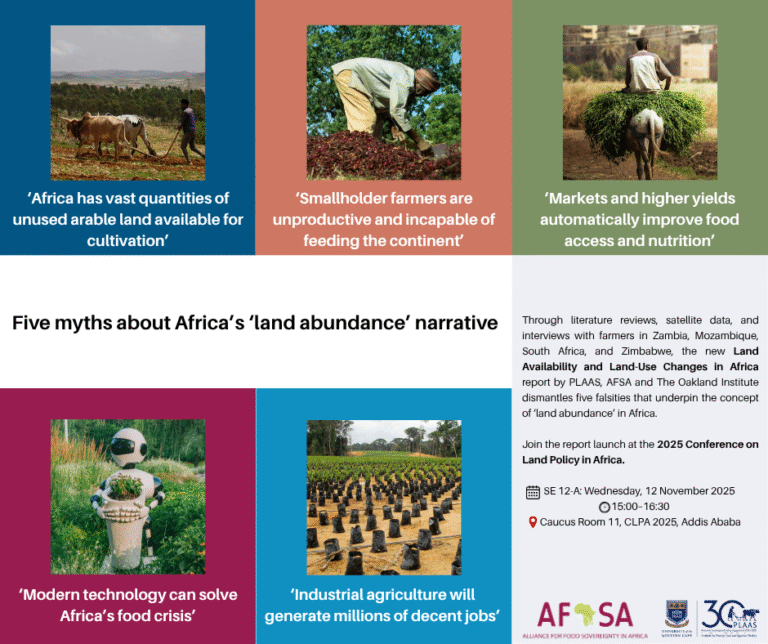
This regime is legitimated by an enduring narrative that portrays African land as abundant and underutilised. Land is framed as empty, idle, marginal, or unproductive unless it generates measurable market output. These claims obscure the social, ecological, and livelihood functions of land that is already intensively used and socially embedded. They also render existing land users politically invisible. Institutions such as the African Development Bank continue to reproduce this frontier imaginary, shaping investment strategies and land governance across the continent.
Against this backdrop, the following sections examine how this regime materialises through distinct but interconnected drivers of land-use change.
The most visible entry point of this regime is the global scramble for critical minerals.
Critical and rare earth minerals are a central driver of land-use changes in Africa under the global regime of extractive territorialisation. Global decarbonisation, electrification, and digitalisation have sharply expanded demand for these minerals. Demand is projected to more than double by 2030 and quadruple by 2050, with annual revenues exceeding USD 400 billion. Africa occupies a strategic position within this regime because it holds close to 30 percent of global critical mineral reserves. This includes 48 percent of cobalt, 40 percent of manganese, and 22 percent of graphite.
The Democratic Republic of the Congo supplies over 70 percent of global cobalt, while lithium extraction is rapidly expanding in Zimbabwe, Namibia, Mali, and Ghana. These projects operate at large territorial scale. Individual concessions cover hundreds of square kilometres. Copper and cobalt mining have driven sustained conversion of forest, cropland, and pastureland in the DRC and Zambia. What distinguishes this process is not extraction alone, but the reorganisation of territory to secure global supply chains. Mining enclaves are connected to transport corridors, energy infrastructure, and export routes that lock land into long-term extractive use.
This reorganisation is globally coordinated. China dominates mineral processing and controls much of cobalt mining in the DRC through state-backed firms. The United States and the European Union have responded through strategic finance and corridor development to secure alternative supply chains (Mining Indaba 2025; Stark 2025). Gulf states have joined this competition through large-scale investments in copper and lithium. This mineral frontier provides a template for how extractive territorialisation is extended into other sectors under climate and development agendas.
Renewable energy represents the next expansion, reframing land not for extraction, but for climate-justified enclosure.
Renewable energy expansion in Africa operates within a regime of globalised extractive territorialisation rather than a neutral energy transition. Decarbonisation imperatives have converted land into a strategic asset for clean energy production. Territory is reorganised to secure external energy needs. Large-scale solar and wind projects depend on African land, sun, and labour, while ownership, finance, and technology remain largely external. This produces land conversion without commensurate energy access or local control.
Read: Land Availability and Land-use Changes in Africa report
This logic is visible across regions. In northern Kenya, the Lake Turkana Wind Power project occupies about 40,000 acres of customary land and generates 310 megawatts. It supplies a significant share of national electricity, while local communities face contested tenure, limited access to power, and weak compensation mechanisms. In North Africa, Egypt’s Benban Solar Park delivers 1.65 gigawatts through extensive transmission corridors. Morocco’s Noor Ouarzazate complex exceeds 500 megawatts and converts semi-arid landscapes into energy fields oriented toward national and export markets. Proposed projects such as the Morocco-United Kingdom interconnector extend this logic by mobilising African land to meet European energy demand.
Across the continent, installed utility-scale solar capacity exceeds 20 gigawatts and continues to grow rapidly. Empirical studies show that renewable corridors often generate dispossession, social marginalisation, and environmental injustice where customary land rights are weak or unrecognised. Renewable energy thus mirrors extractive industries by reorganising territory for external accumulation.
This logic of enclosure intensifies further where land is converted not for energy production itself, but for the abstraction and trade of carbon.
Carbon markets have become a central mechanism through which globalised extractive territorialisation operates in Africa.
Under climate mitigation agendas, land is redefined as a carbon asset. Territory is reorganised to serve external emissions reduction needs rather than local livelihoods. This process takes the form of large-scale land appropriation for carbon sequestration, tree planting, and biodiversity offsets. These green grabs now constitute around 20 percent of all global land grabs. Governments have pledged nearly one billion hectares for land-based carbon removal. Africa hosts a disproportionate share of this targeted land.
This logic has been institutionalised through initiatives such as the Africa Carbon Markets Initiative. The initiative seeks to scale voluntary carbon markets to 300 million credits annually by 2030 and 1.5 billion by 2050, projecting revenues exceeding USD 120 billion. These ambitions rely on the commodification of carbon as a tradable unit, privileging measurable stocks over existing land uses and social relations.
Five countries account for roughly 65 percent of all African carbon credit issuances. Kenya leads, followed by Zimbabwe, the Democratic Republic of the Congo, Ethiopia, and Uganda. REDD+ programmes in the Congo Basin illustrate this regime clearly. The Basin stores 30 to 40 billion tonnes of carbon and is home to around 75 million people. Conservation is enacted through enclosure and monitoring, restricting customary land uses. Forests are transformed into carbon sinks for Northern emissions. Carbon markets thus resolve global climate pressures while reproducing dispossession and long-term constraints on local land access. Where renewable energy reorganises land for energy flows, carbon markets reorganise land for financialised climate offsets.
Population dynamics are a critical but mischaracterised driver of land-use change in Africa.
These sectoral pressures do not operate in isolation. They intersect with demographic change in ways that intensify land competition rather than explain it away. Population growth does not operate independently. It interacts with land scarcity, agrarian structure, and uneven development shaped by the global political economy. While global population growth is slowing, Africa’s demographic trajectory diverges sharply. The continent is projected to account for one quarter of the global population by mid-century and a large share of global births (UN 2024; Walsh 2023).
Africa’s population is expected to reach 2.5 billion by 2050. More than half of global population growth will occur in Nigeria, the Democratic Republic of the Congo, Ethiopia, Tanzania, and Angola. Growth is spatially uneven and concentrated in land-constrained rural and peri-urban zones. Population densities already exceed 100 people per square kilometre in several countries (Headey and Jayne 2014).
In these contexts, demographic change does not create new land. It intensifies subdivision, shortens fallow cycles, and accelerates conversion of forests, grasslands, wetlands, and marginal lands. The outcome is heightened competition over already used landscapes. Population, therefore, functions as a multiplier within an extractive territorial regime. It amplifies pressures generated by agriculture, mining, urbanisation, renewable energy, and carbon markets. This exposes the limits of demographic explanations detached from political economy and land governance. Population, therefore, amplifies extractive territorial pressures rather than constituting their root cause.
Urbanisation is one of the primary spatial mechanisms through which these compounded pressures are territorialised.
Urbanisation translates population growth and economic restructuring into large-scale conversion of farmland, wetlands, forests, and peri-urban commons. Africa remains less urbanised than other regions, with about 43 percent of its population living in cities. Yet it is urbanising faster than any other region, at about 3.5 percent per year.
Africa’s urban population increased from fewer than 30 million in 1950 to over 600 million by 2020. It is projected to approach one billion by 2050. Since 1990, the number of cities has more than doubled. Urban land area has expanded faster than urban population growth, reflecting low-density sprawl rather than compact urbanisation.
This pattern intensifies pressure on surrounding farmland and ecosystems. In Accra, urban land expanded at more than twice the rate of population growth. Metropolitan regions such as Lagos, Kinshasa, Cairo, Nairobi, and Johannesburg, Pretoria now host over ten million residents each. Weak planning systems and limited infrastructure investment reinforce outward expansion. Urbanisation thus reshapes land markets and accelerates peri-urban dispossession with long-term consequences for food systems and ecological sustainability. It converts demographic pressure into permanent land reallocation.
Agriculture remains the sector where these pressures converge most directly on everyday livelihoods.
Land-use changes reflect the growing commodification and corporatisation of crops within global and regional agri-food systems, not primarily due to smallholder farming itself. Since the early 2000s, sub–Saharan Africa has recorded the fastest rate of agricultural expansion globally. Nearly three-quarters of this growth occurred through area expansion rather than yield intensification.
Expansion is shaped by export demand and state-backed visions of scale. Medium-scale farmers operating between 5 and 100 hectares now account for a large share of new cultivated land. They exceed 50 percent in Ghana and about 40 percent in Zambia and Tanzania. Small-scale farmers are not passive agents. They respond rationally to insecure tenure, climate stress, declining soil fertility, limited non-farm employment, and rising food and cash needs.
At the same time, policy imaginaries promote transformation through scale. The African Development Bank Feed Africa strategy commits more than USD 60 billion to agricultural corridors across 40 countries. It requires 25.7 million hectares and affects over 11 million smallholder farmers. This convergence intensifies competition over land and marginalises agroecological alternatives. These land-use changes reflect a political economy that privileges commodification and territorial scale. Agriculture, therefore, anchors extractive territorialisation in rural space through commodification rather than subsistence failure.
Infrastructure and timber complete this regime by physically locking land into extractive and material supply chains.
Construction and timber demand operate as a consolidated driver of land-use changes under globalised extractive territorialisation. Land is reorganised to support infrastructure expansion and material extraction serving external growth trajectories. Global wood demand is projected to increase by 54 percent between 2010 and 2050. This requires extensive land conversion and raises net atmospheric carbon.
China’s Belt and Road Initiative has become a central territorial mechanism. Fifty-three African Union member states participate. USD 21.7 billion in construction deals were signed in 2023 alone. Chinese firms member states participate. USD 21.7 billion in construction deals were signed in 2023 alone. Chinese firms dominate major construction projects, accounting for about 31 percent of large projects. Timber extraction is tightly linked to this boom. China receives more than three-quarters of Africa’s timber exports and imported 1.46 million cubic metres in the first half of 2024.
Logging concessions concentrate in Central and Southern Africa. They convert forests into extractive territories and undermine livelihoods (Rotberg 2019). Mozambique’s export of protected rosewood despite legal bans illustrates weak enforcement (ADF 2024). Construction and timber thus mobilise African land for global accumulation.
Read together, these drivers constitute a single political-economic regime of land pressure in Africa. This regime is best understood as globalised extractive territorialisation. It is shaped by decarbonisation imperatives, agri-food commodification, infrastructure-led development, and geopolitical competition. It is legitimised through narratives of land abundance and underutilisation. It is operationalised through corridors, concessions, market-based climate instruments, and scale-driven strategies. These mechanisms intensify competition over already used land. The outcome is a cumulative tightening of land access. Land is reallocated away from smallholders, pastoralists, and forest-dependent communities toward capital-intensive uses. Africa’s land-use changes are not accidental. They express a coherent global regime that resolves climate, food, and energy crises for some while deepening land scarcity and inequality for others.
We wish to express our sincere appreciation to our partners on the Land Availability and Land-use Changes in Africa study, the Alliance for Food Sovereignty in Africa. We thank the Institute for Agriculture and Trade Policy and the Oakland Institute for their partnership and support throughout the study.
References
- International Energy Agency (IEA). (2022). “World Energy Outlook 2022.” IEA, Paris. Available at: https://www.iea.org/reports/world-energy-outlook-2022 (Accessed 9 November 2024).
- Pan African Climate Justice Alliance (PACJA). (2024). “Critical Minerals: A curse or blessing? Africa stakeholders debate in South Africa”. Available at https://pacja.org/critical-minerals-a-curse-or-blessing-africa-stakeholders-debate-in-south-africa/ (Accessed 13 November 2024)
- United Nations Trade and Development (UNCTAD), 2024. “Critical minerals: Africa holds key to sustainable energy future”. Available from: https://unctad.org/news/critical-minerals-africa-holds-key-sustainable-energy-future (Accessed 8 November 2024).
- Dunlap, R.A., 2024. Renewable Energy: Requirements and Sources. Springer Nature.
- Allen, M., Friedlingstein, P., Girardin, C., Jenkins, S., Malhi, Y., Mitchell-Larson, E., Peters, G, and Rajamani, L. (2022) “Net Zero: Science, Origins, and Implications” in Annual Review of Environment and Resources, Vol. 47, 849-887.
- Leach, M. I. and Scoones, I. (2015). “Political ecologies of carbon in Africa”. In: Leach, M.I. and Scoones, I. (eds) Carbon Conflicts and Forest Landscapes in Africa. London: Routledge.
- OECD/UNECA/AfDB (2022). “Africa’s urbanisation dynamics 2022: The economic power of Africa’s cities”. West African Studies. OECD Publishing, Paris. Available at: https://doi.org/10.1787/3834ed5b-en. (Accessed 26 November 2024).
- Dodman, D., Leck, H., Rusca, M. and Colenbrander, S. (2017). “African urbanisation and urbanism: Implications for risk accumulation and reduction”. International Journal of Disaster Risk Reduction, 26, 7-15. Available at: https://doi.org/10.1016/j.ijdrr.2017.06.029. (Accessed 27 November 2024).
- Jane, S.T. and Sanchez, P.A. (2021). “Agricultural productivity must improve in sub-Saharan Africa”. Science, 372 (6546), pp. 1045-1047. Available at: https://doi.org/10.1126/science.abf5413. (Accessed 16 November 2024)
- Jayne. S.T., Muyanga, M., Wineman, A., Ghebru, H., Stevens, C., Stickler, M., Chapoto, A., Anseeuw, W., Van der Westhuisen, D., and Nyange, D. (2019). “Are medium-scale farms driving agricultural transformation in sub-Saharan Africa?”Agricultural Economics, 50 (S1): 75-95. Available at: https://doi.org/10.1111/agec.12535.
- Searchinger, T., Peng, L., Zionts, J., and Waite, R. (2023). “The global land squeeze: Managing the growing competition for land”. World Resources Institute. Available at: https://www.wri.org/research/global-land-squeeze-managing-growing-competition-land (Accessed 8 November 2024)
